|
Double Chevron [M] pattern [S] Twist [worked right to left] |
|
Headstick Set Up Double chevron [M] pattern [S] twist interlinked fingerweaving tutorial patter will be worked from the right hand side to the left hand side of the workpiece. The hedstick is set up using two contrasting colors for the chevron pattern and a third color for borders. The total number of strands of each color must be divisible by four. For this tutorial the strands are cast on to the headstick in the following order: 6 [border color], 4 [color 1], 8 [color 2], 8 [color 1], 8 [color 2], 4 [color 1],6 [border color]. The shed is picked up on the index finger of the left hand. The bottom layer of the shed is under the index finger. The top layer of the shed is over the index finger. [NOTE] The headstick is set up so that the first strand on the right hand side of the workpiece is in the bottom layer of the shed. |
[figure-1]
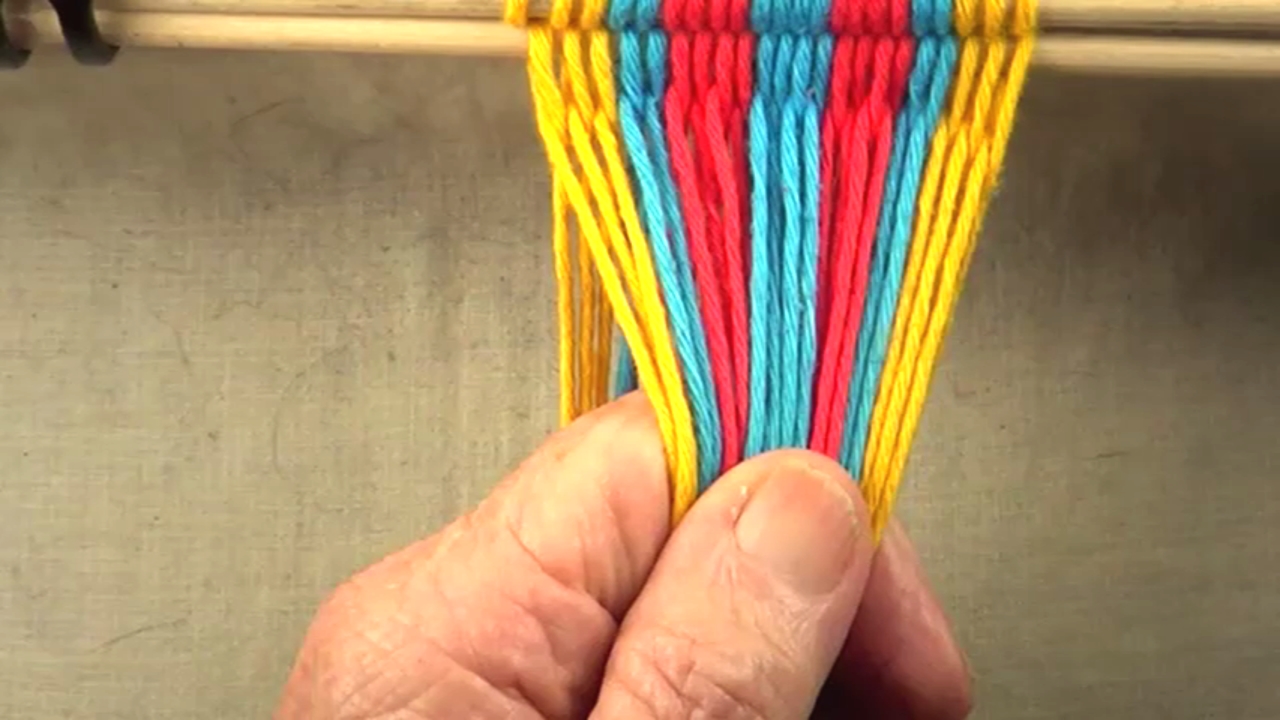
|
| Go to: Top of page | Next |
|
First Pass--Section One
Starting on the right hand side of the workpiece, weave [S] twist interlink fingerweaving. [OBSERVE] the first top two strand are moved to the bottom layer of the shede. |
[figure-2]
[click here to see video]
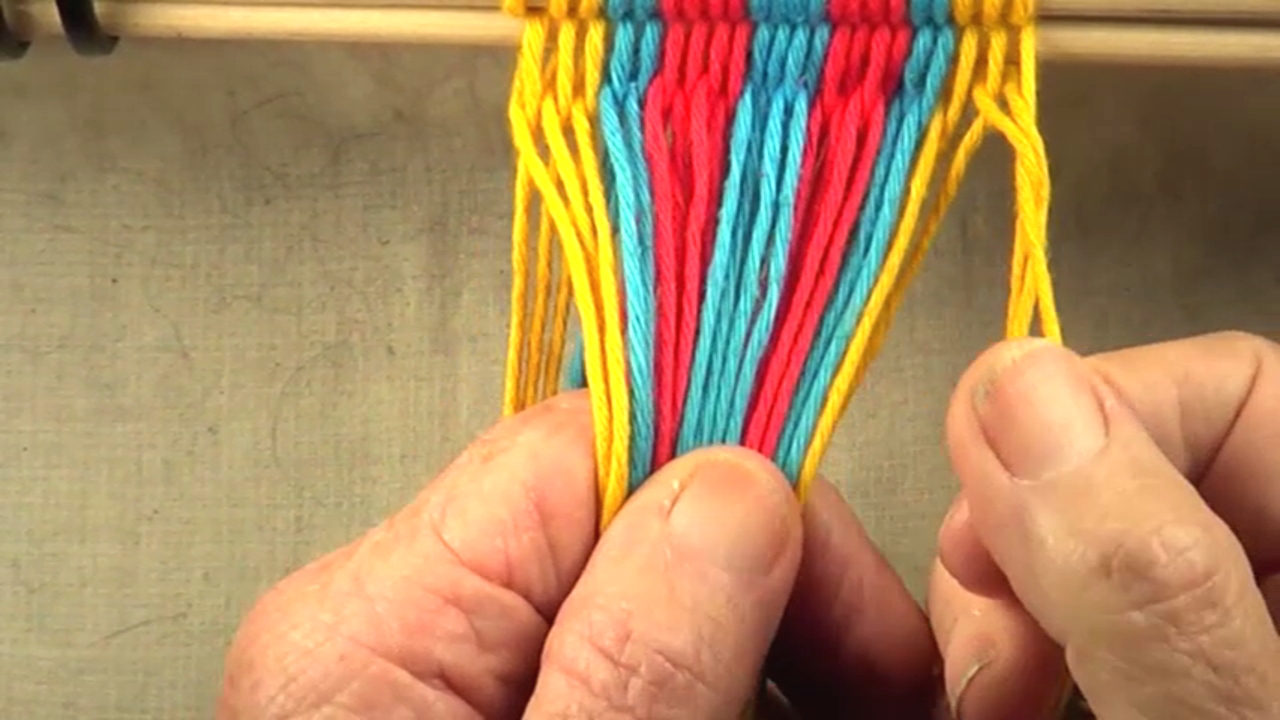
|
| Previous | Next |
|
First Pass--Section One
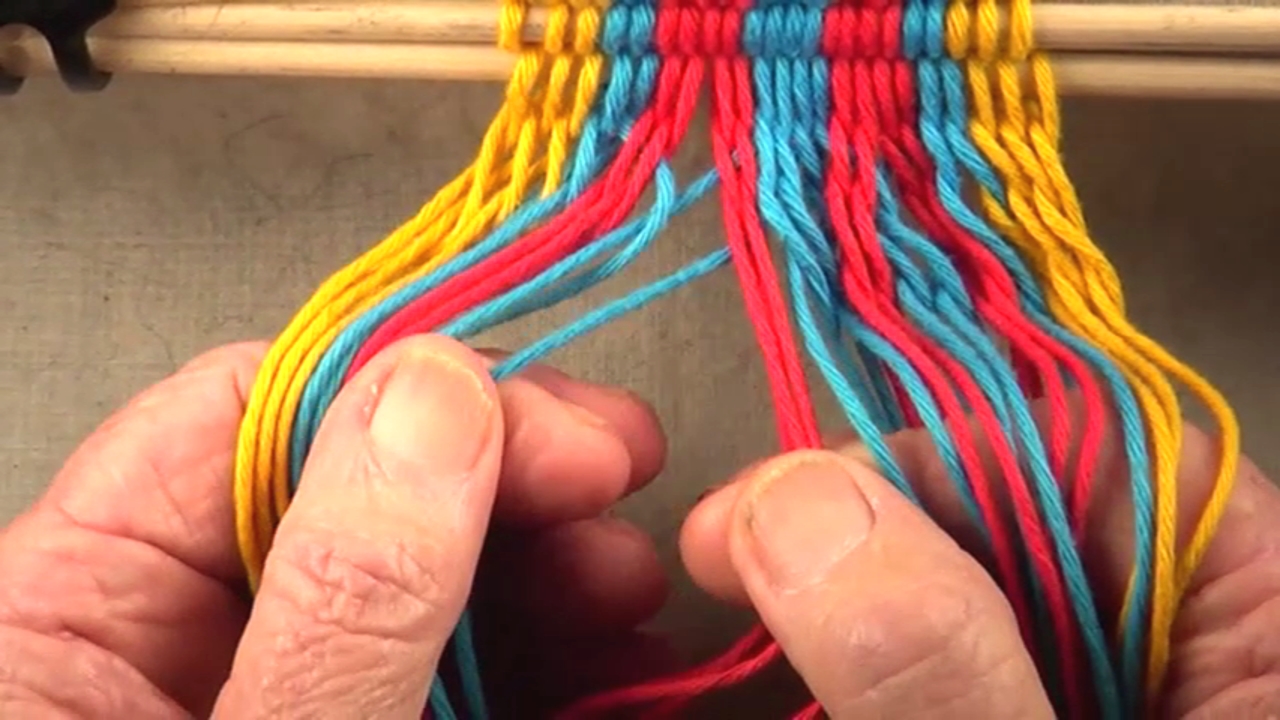
Continue [S] twist interlink fingerweaving weave until one strand of the first chevron color band is unused. |
[figure-3]
[click here to see video]
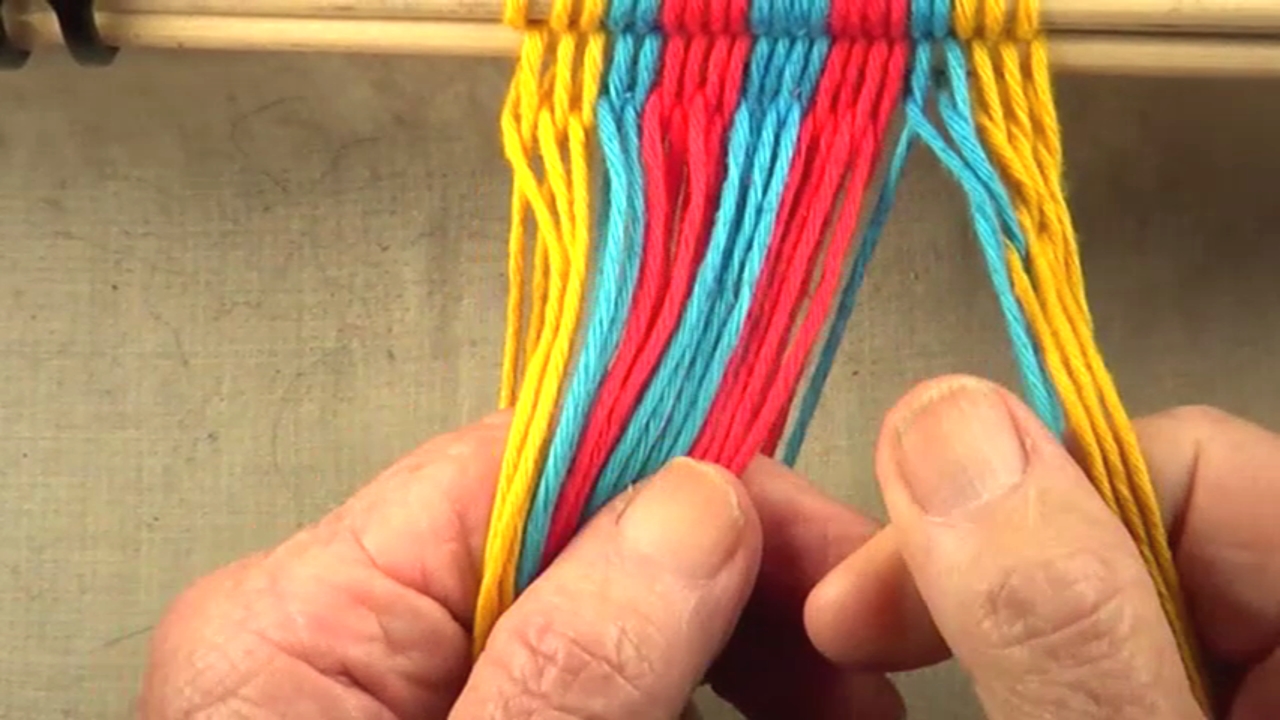
|
| Previous | Next |
|
First Pass--Section One
[NOTE] The strands of the second chevron color band on the right hand side are used as twining strands. [NOTE] The twining strand form the legs of the cheveron pattern. Pass the unused interlink strand through the shed of to the center of the second chevron color band. [NOTE] The second chevron color band is used as the first and second sets of twining strands. |
[figure-4]
[click here to see video]
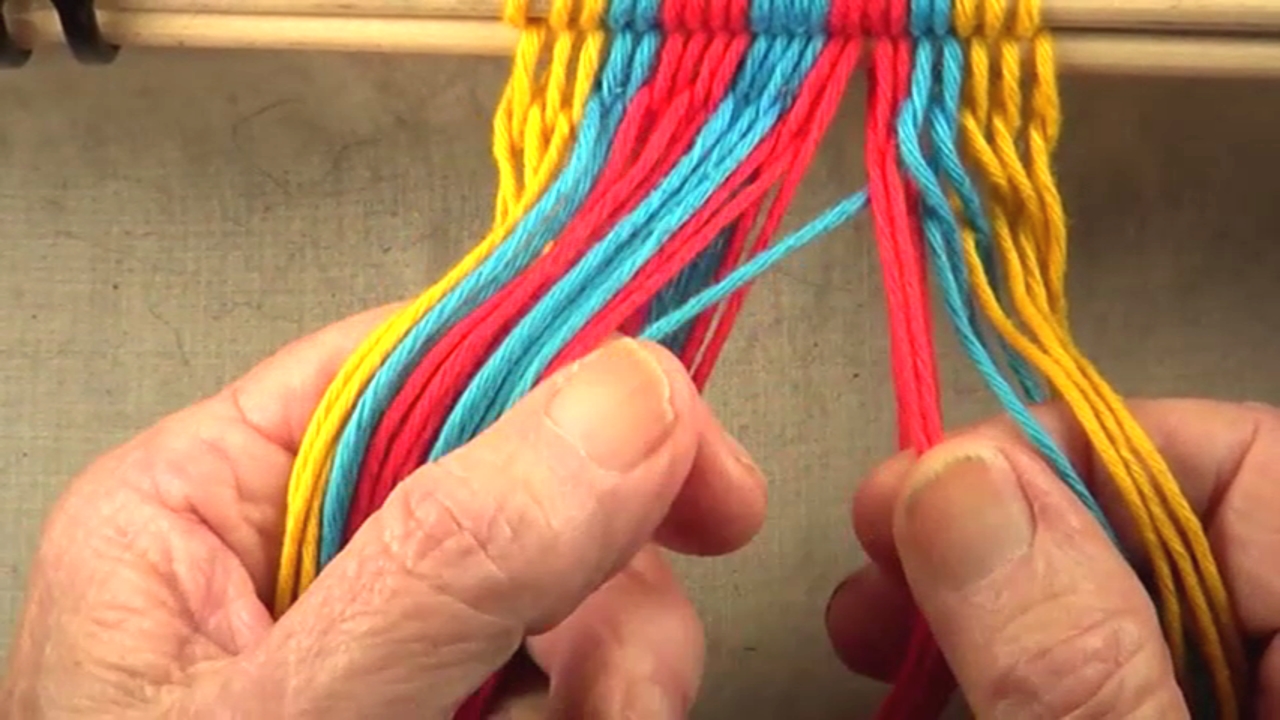
|
| Previous | Next |
|
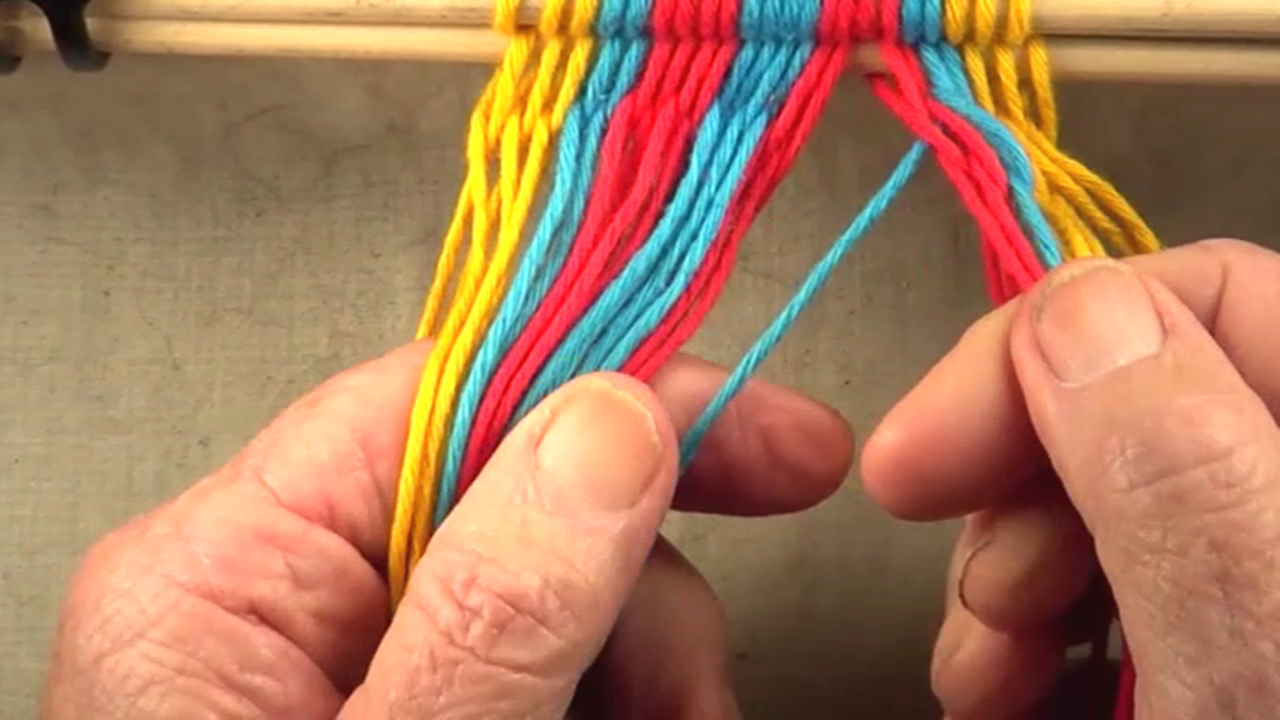
First Pass--Section One
[S] twist twine the first set of twining strands. [NOTE]The first set of twining strands will become the right hand leg of the first right hand point up cheveron. [NOTE] The interlink strand acts as a weft strand for the twining strands. |
[figure-5]
[click here to see video]
|
| Previous | Next |
|
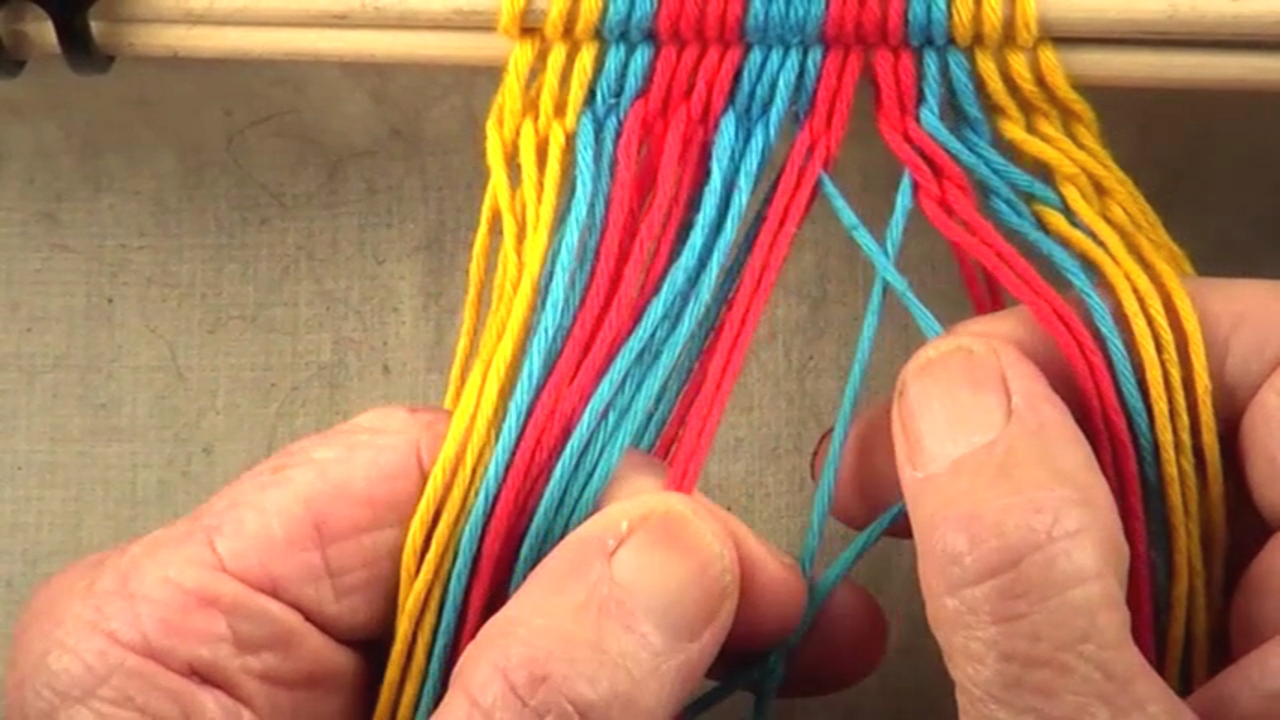
First Pass--Section One
Pass the first top strand of the center color band through the second set of twining strands. |
[figure-6]
[click here to see video]
|
| Previous | Next |
|
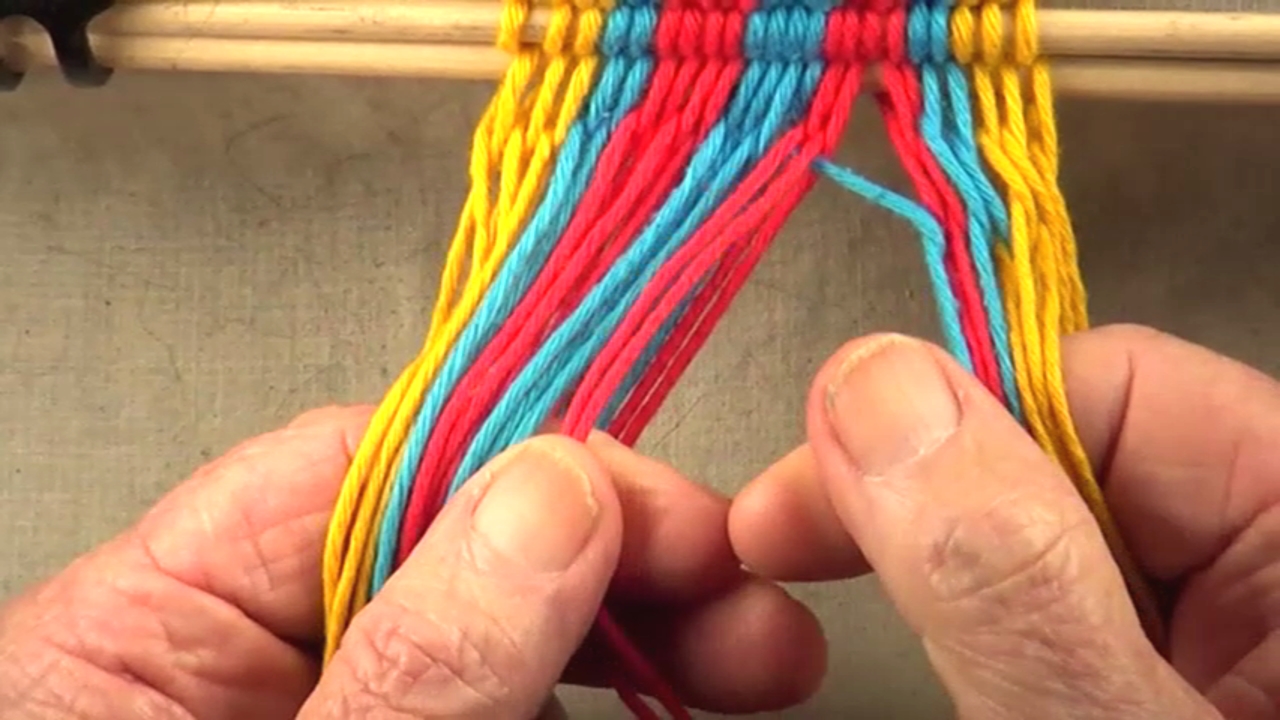
First Pass--Section One
Complete the interlink weaving stitch. The completed stitch will be the apex of the right hand side point up chevron part of the [M] pattern double chevron. [NOTE] The interlink strand acts as a weft strand for the twining strands. |
[figure-7]
[click here to see video]
|
| Previous | Next |
|
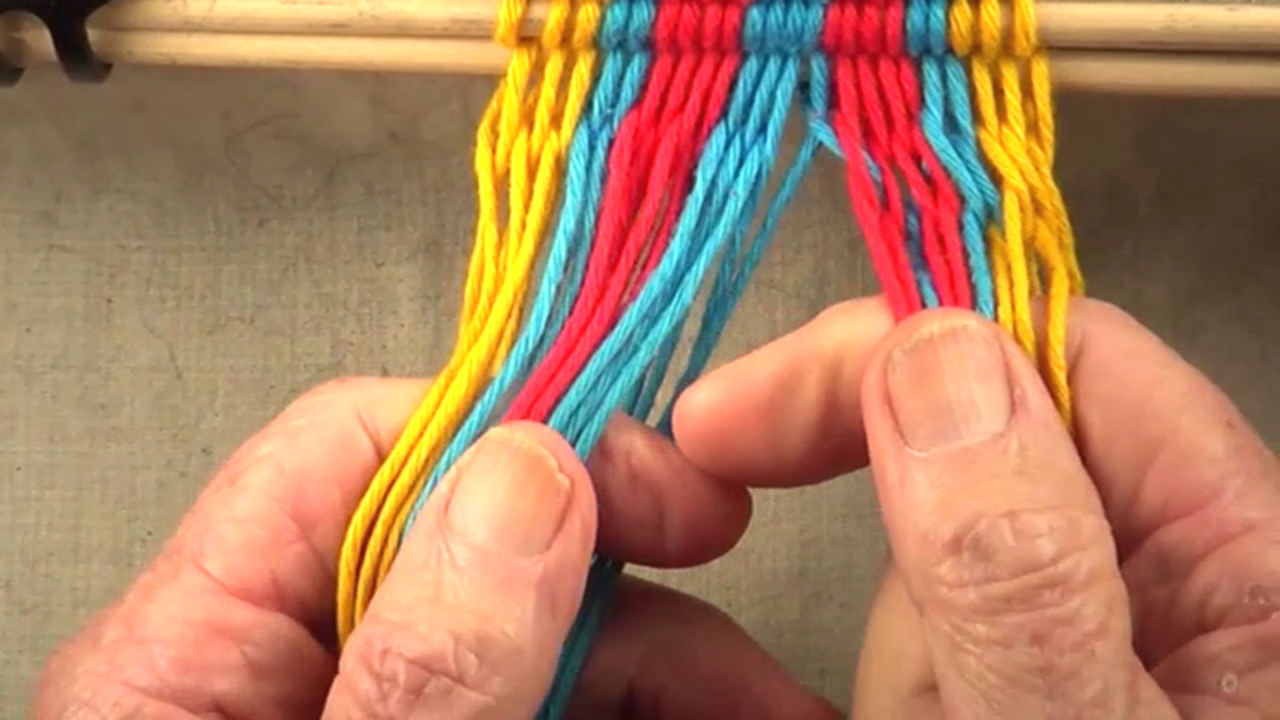
First Pass--Section One
[S] twist twine the second set of twining strands. [NOTE]The second set of twining strands will become the left hand leg of the right hand point up cheveron and also the right hand leg of the point down chevron the middle part of the [M] pattern double chevron. [NOTE] The interlink strand acts as a weft strand for the twining strands. |
[figure-8]
[click here to see video]
|
| Previous | Next |
|
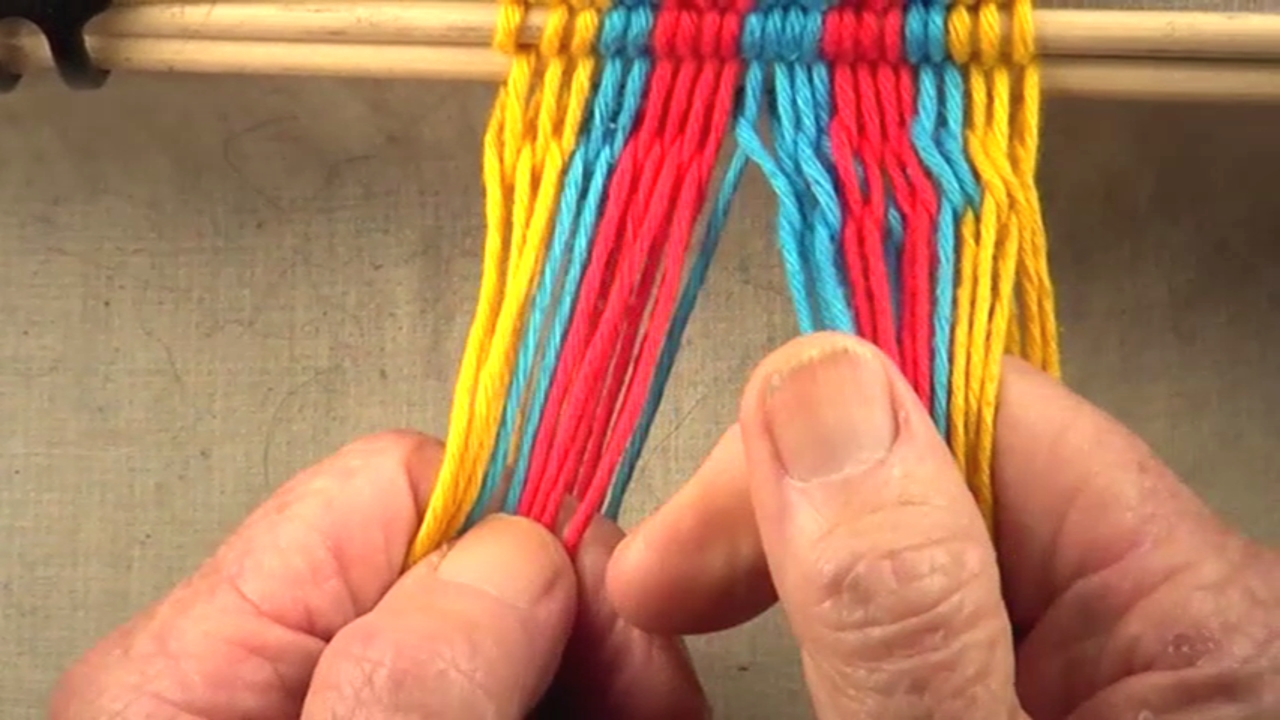
First Pass--Section One
Continue [S] twist interlink fingerweaving untill there is one remainning unused strand of the center color band. |
[figure-9]
[click here to see video]
|
| Previous | Next |
|
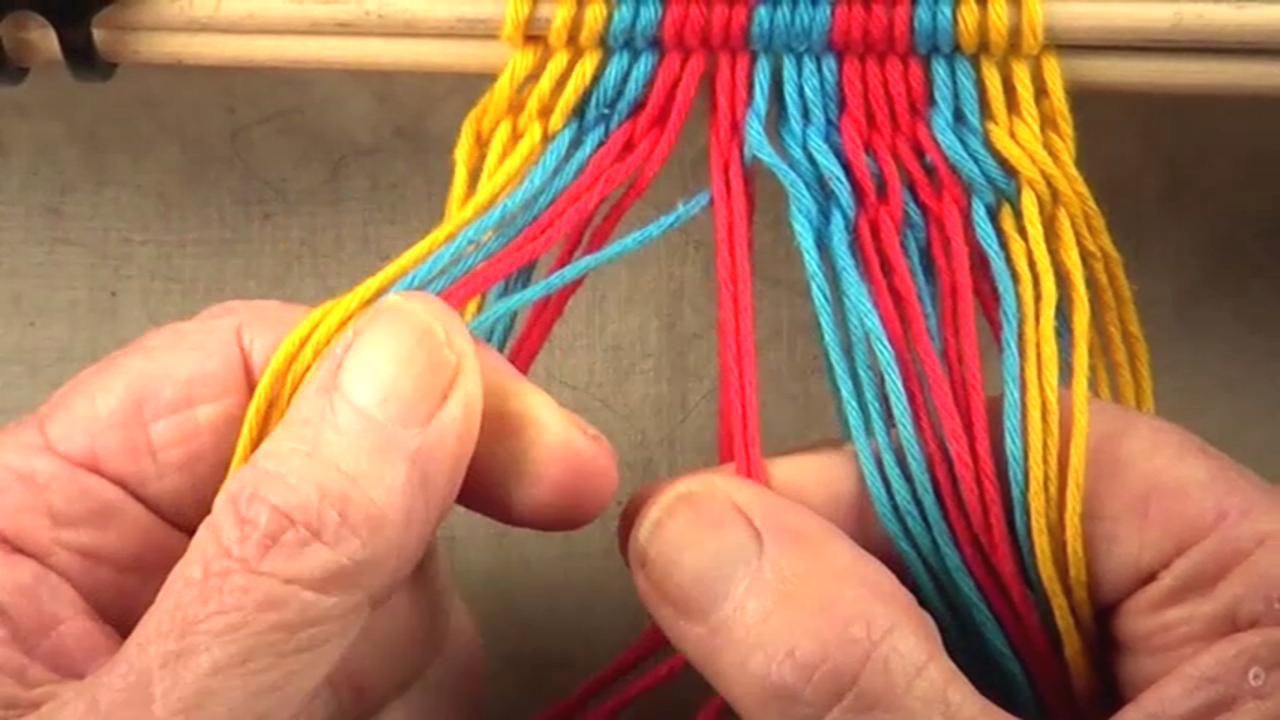
First Pass--Section One
[NOTE]The next color band will be used as the third and fourth set of twining strands. Pass the unused strand of the center color band through the shed to the center of the next color band. [NOTE]The right had side of the color band is the third set of twining strands. |
[figure-10]
[click here to see video]
|
| Previous | Next |
|
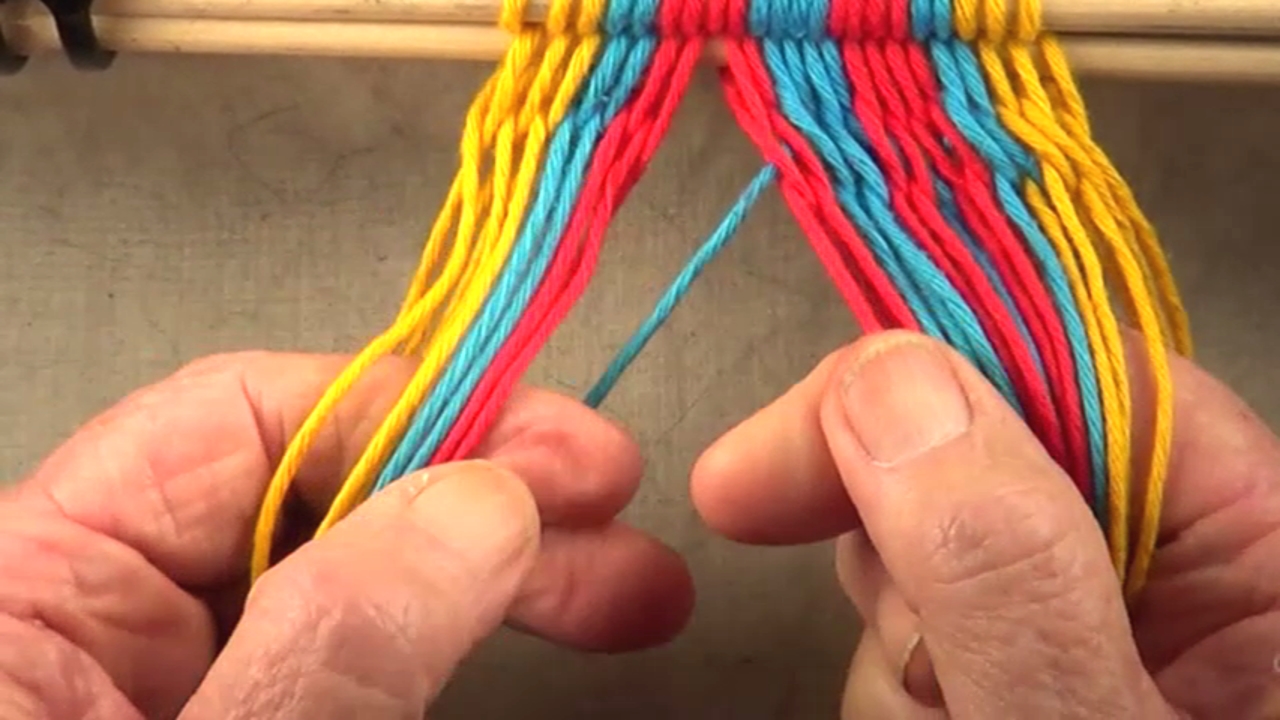
First Pass--Section One
[S] twist twine the the third set of twining strands. [NOTE]The third set of twining strands will become the right hand leg of the left hand point up cheveron and also the left hand leg of the point down chevron. [NOTE] The interlink strand acts as a weft strand for the twining strands. |
[figure-11]
[click here to see video]
|
| Previous | Next |
|
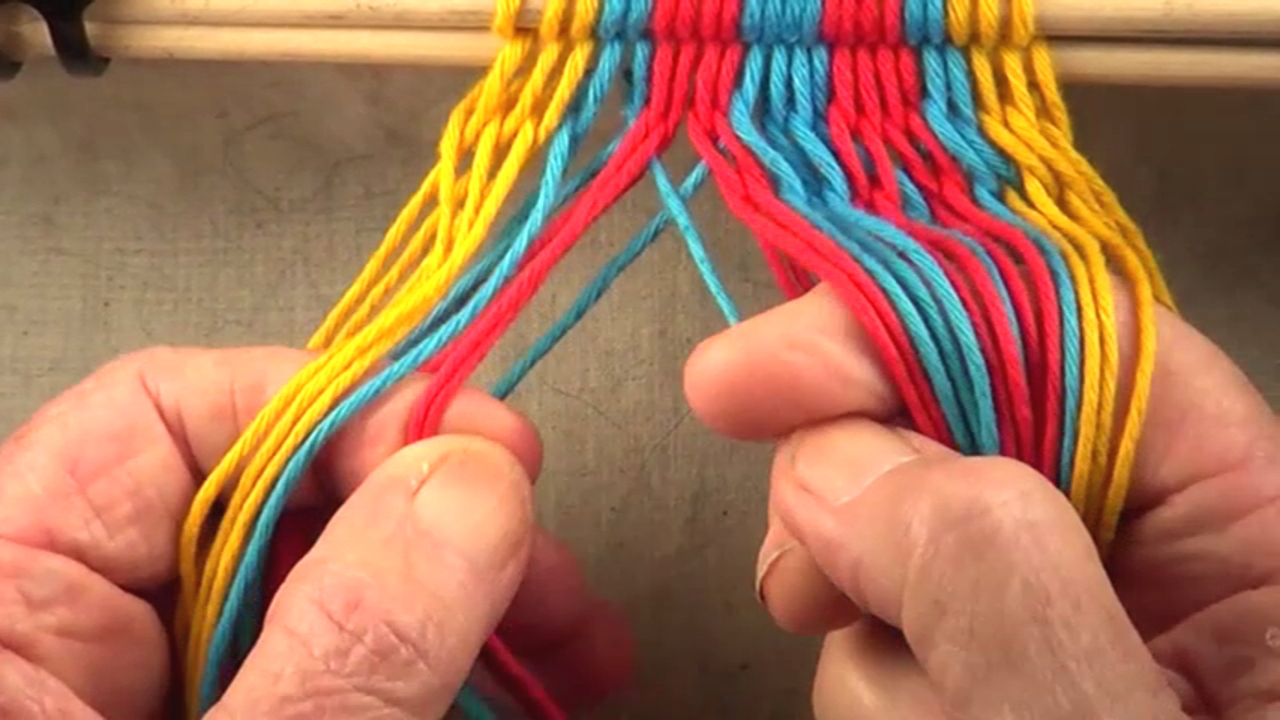
First Pass--Section One
Pass the first top strand of the next color band through the fourth set of twining strands. |
[figure-12]
[click here to see video]
|
| Previous | Next |
|
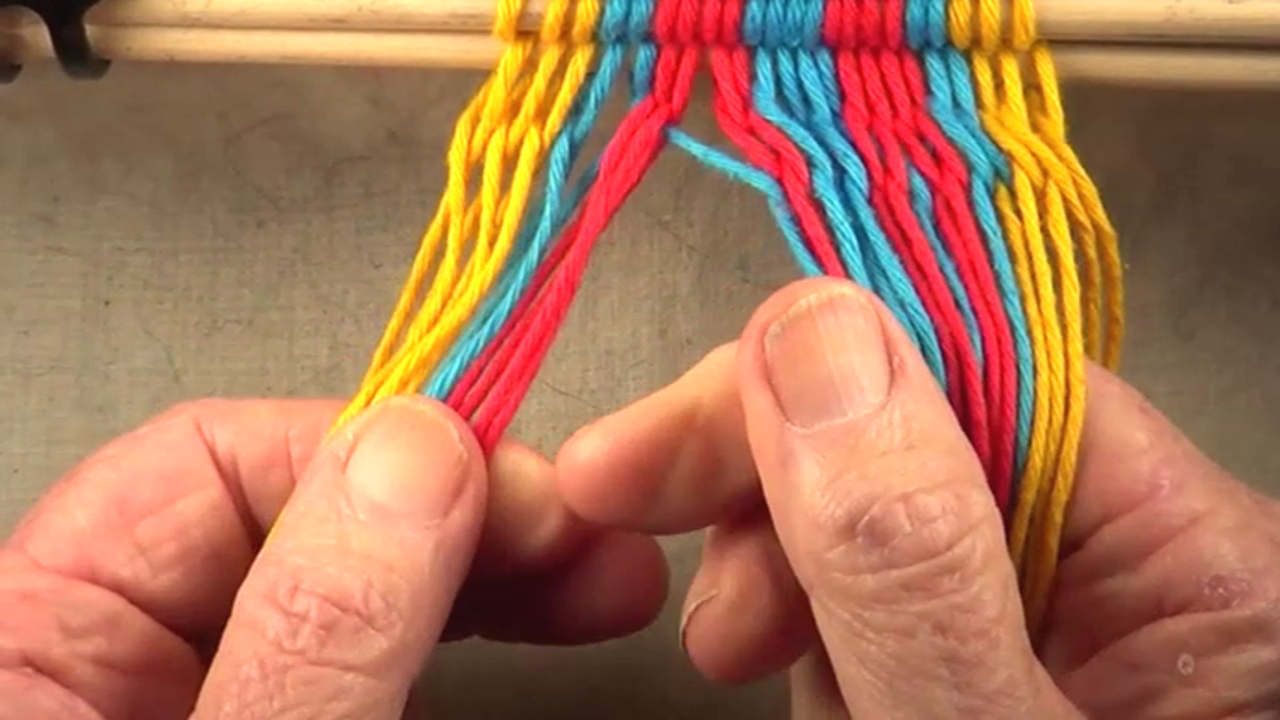
First Pass--Section One
Complete the interlink weaving stitch. The completed stitch will be the apex of the left hand side point up chevron part of the [M] pattern double chevron. |
[figure-13]
[click here to see video]
|
| Previous | Next |
|
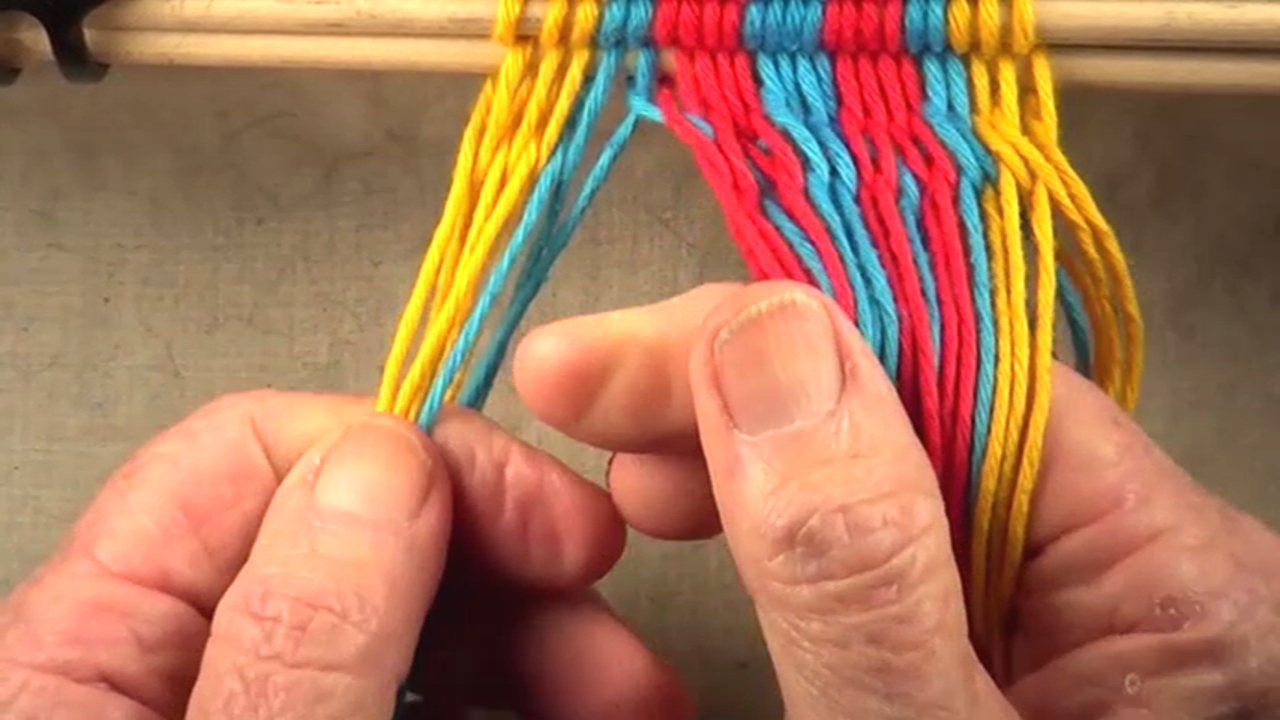
First Pass--Section One
[S] twist twine the fourth set twining color strands. [NOTE]The fourth set of twining strands will become the left hand leg of the left hand point down cheveron. [NOTE] The interlink strand acts as a weft strand for the twining strands. |
[figure-14]
[click here to see video]
|
| Previous | Next |
|
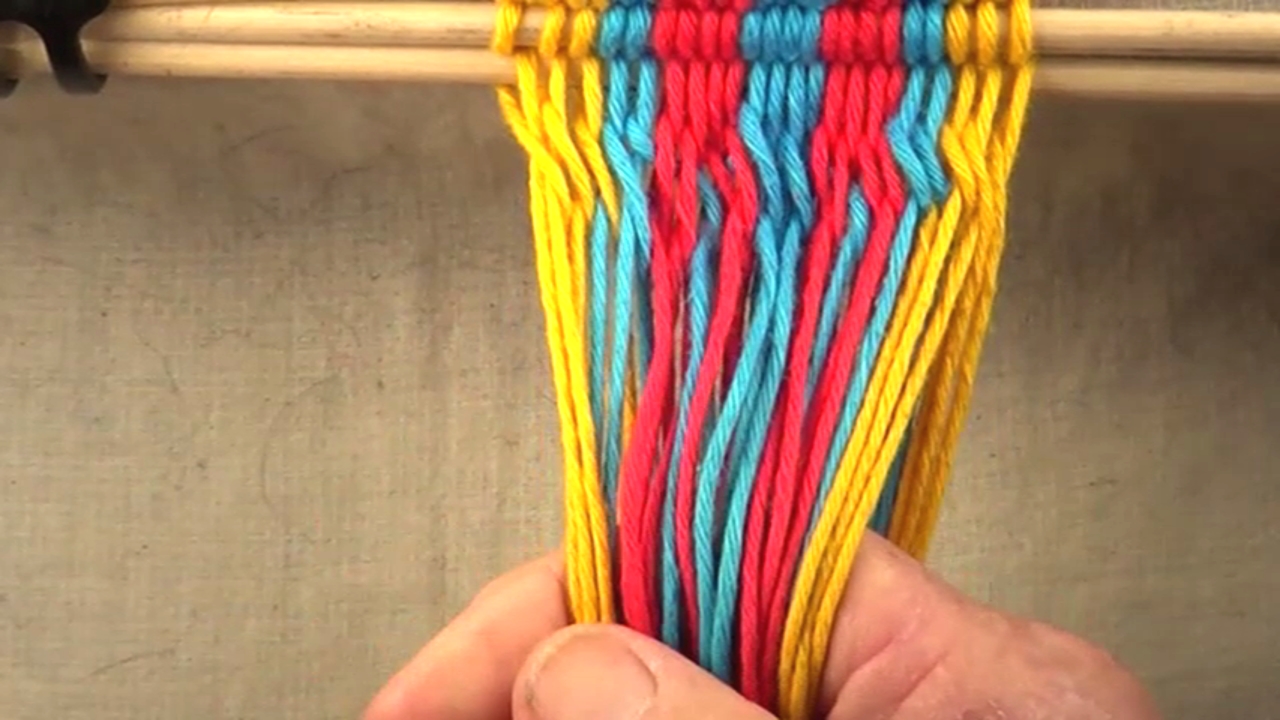
First Pass--Section One
Finish the first pass of section one of interlinked fingerweaving. |
[figure-15]
[click here to see video]
|
| Previous | Next |
|
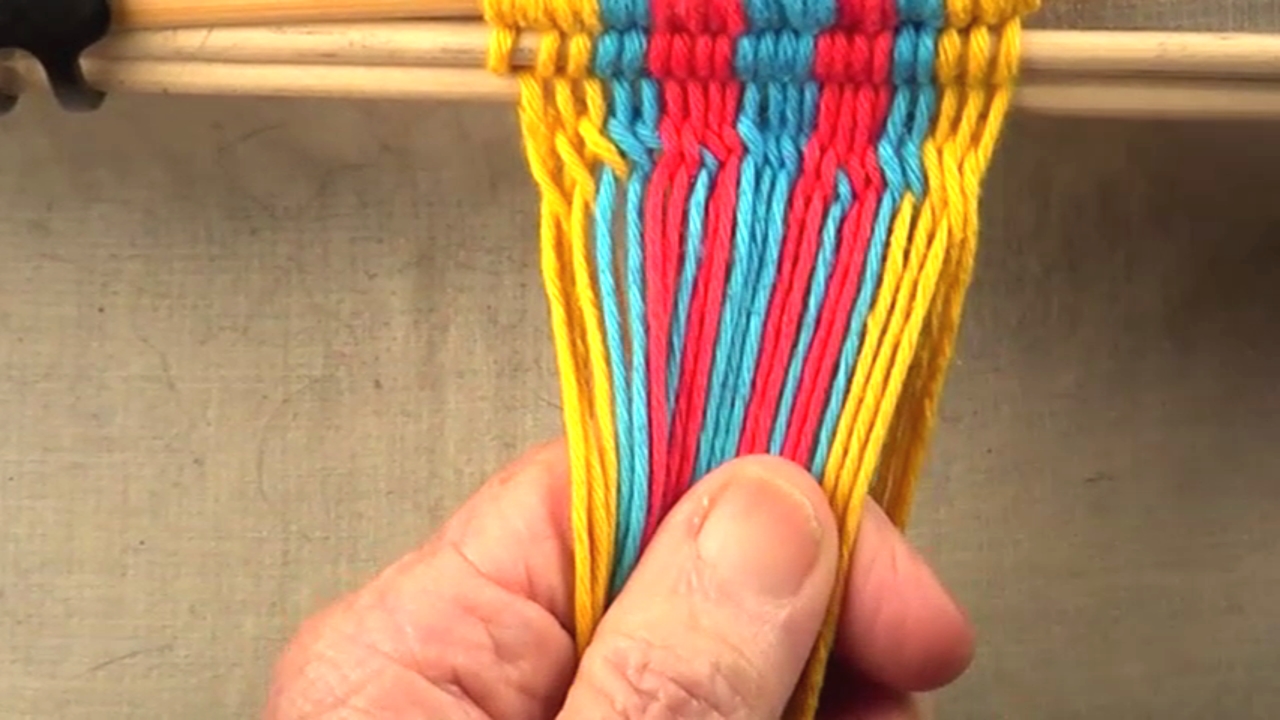
First Pass--Section One
Set the weave by pulling the layers of the shed in opposiite directions. Check to see that there are no loose strands. |
[figure-16]
[click here to see video]
|
| Previous | Next |
|
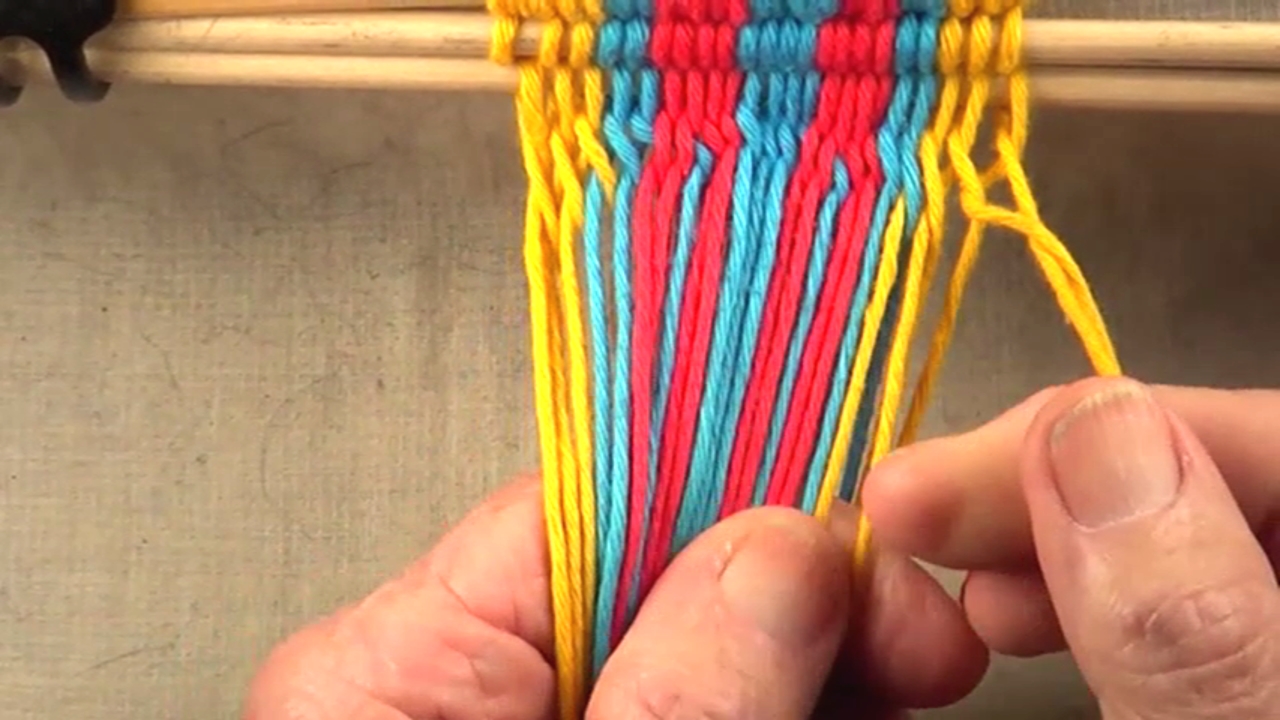
Second Pass--Section One
Start [S] twist interlink fingerweaving on the right hand side of the workpiece. [OBSERVE] This time there is only one strand moved to the bottom layer of the shed. |
[figure-17]
[click here to see video]
|
| Previous | Next |
|
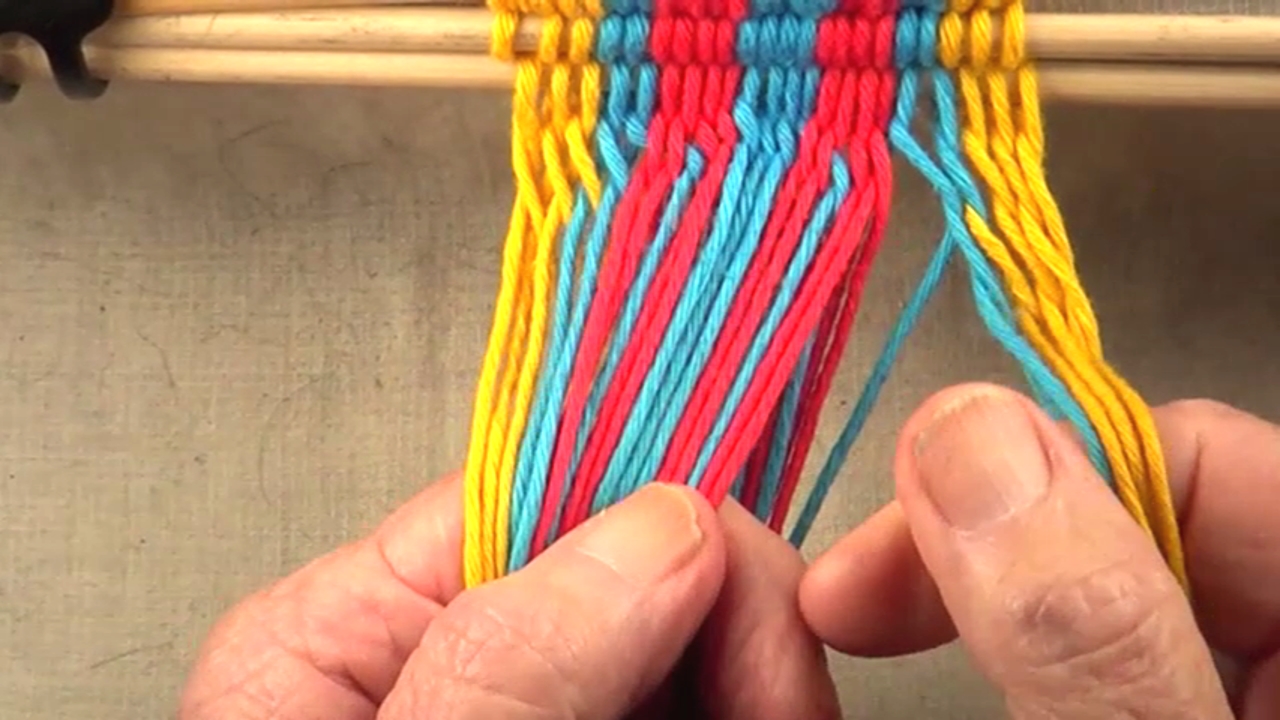
Second Pass--Section One
Continue [S] twist interlinked fingerweaving untill there is only one unused strand of the first chevron color band. |
[figure-18]
[click here to see video]
|
| Previous | Next |
|
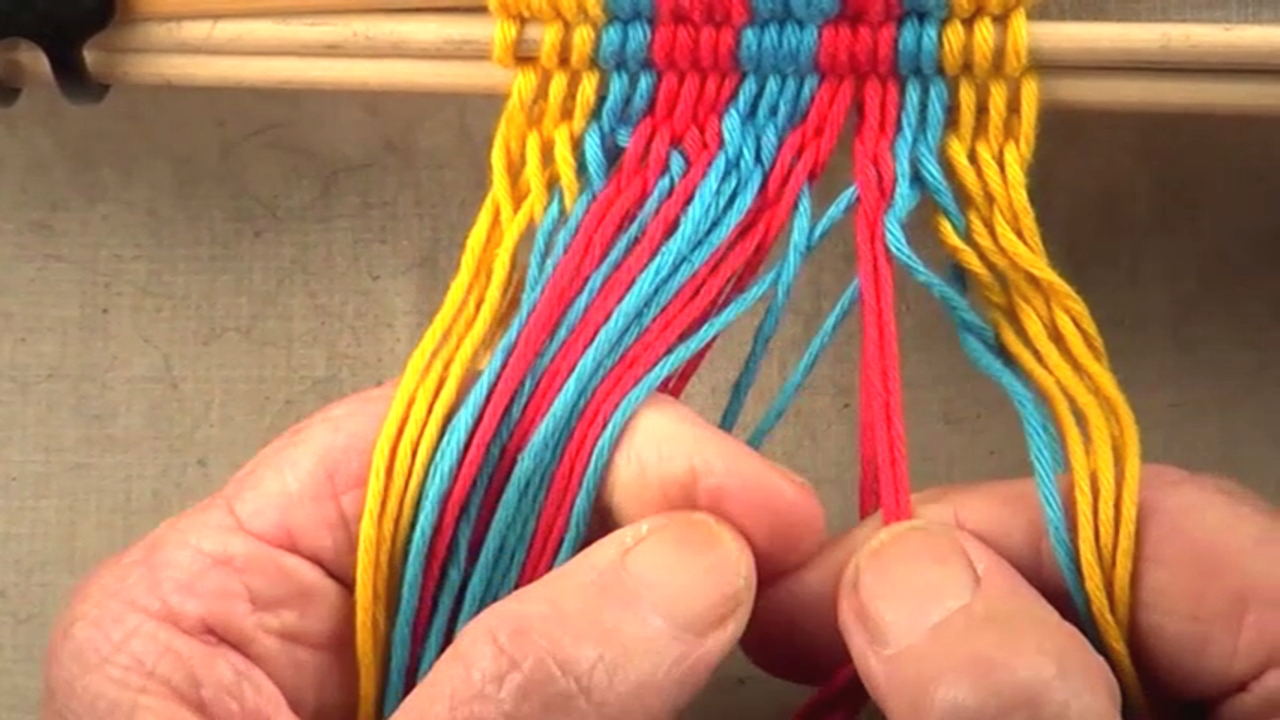
Second Pass--Section One
Pass the unused strand through the shed of the first set of twining strands. |
[figure-19]
[click here to see video]
|
| Previous | Next |
|
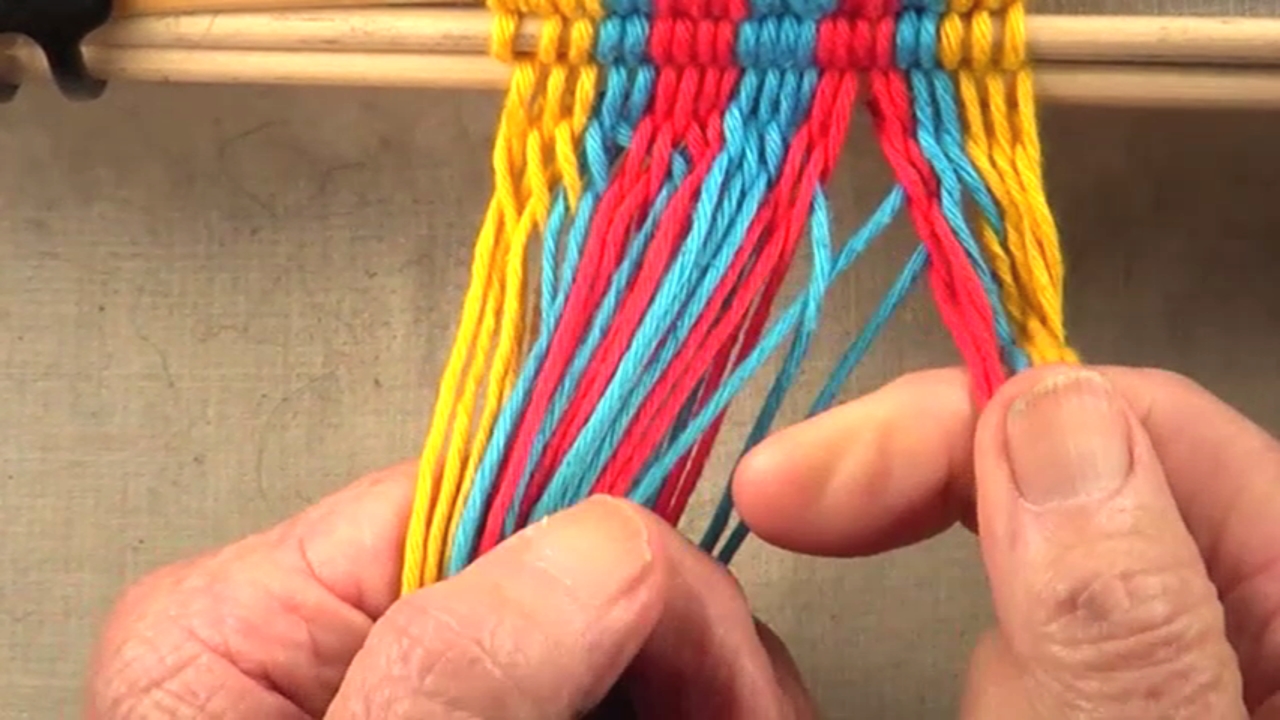
Second Pass--Section One
[S] twist twine the first set of twining strands. [NOTE] The interlink strand acts as a weft strand for the twining strands. |
[figure-20]
[click here to see video]
|
| Previous | Next |
|
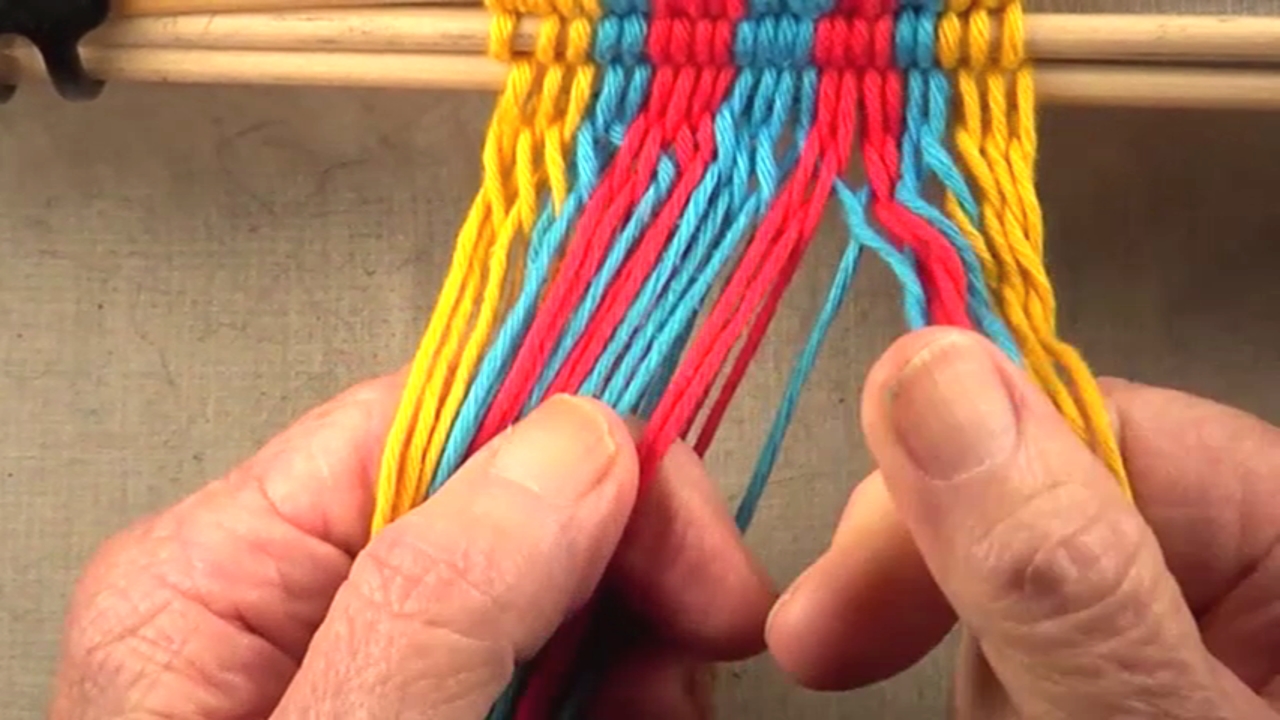
Second Pass--Section One
[S] twist interlink the next part of the chevron color band. Stop when there is one unused strand of the next part of the chevron color band. |
[figure-21]
[click here to see video]
|
| Previous | Next |
|
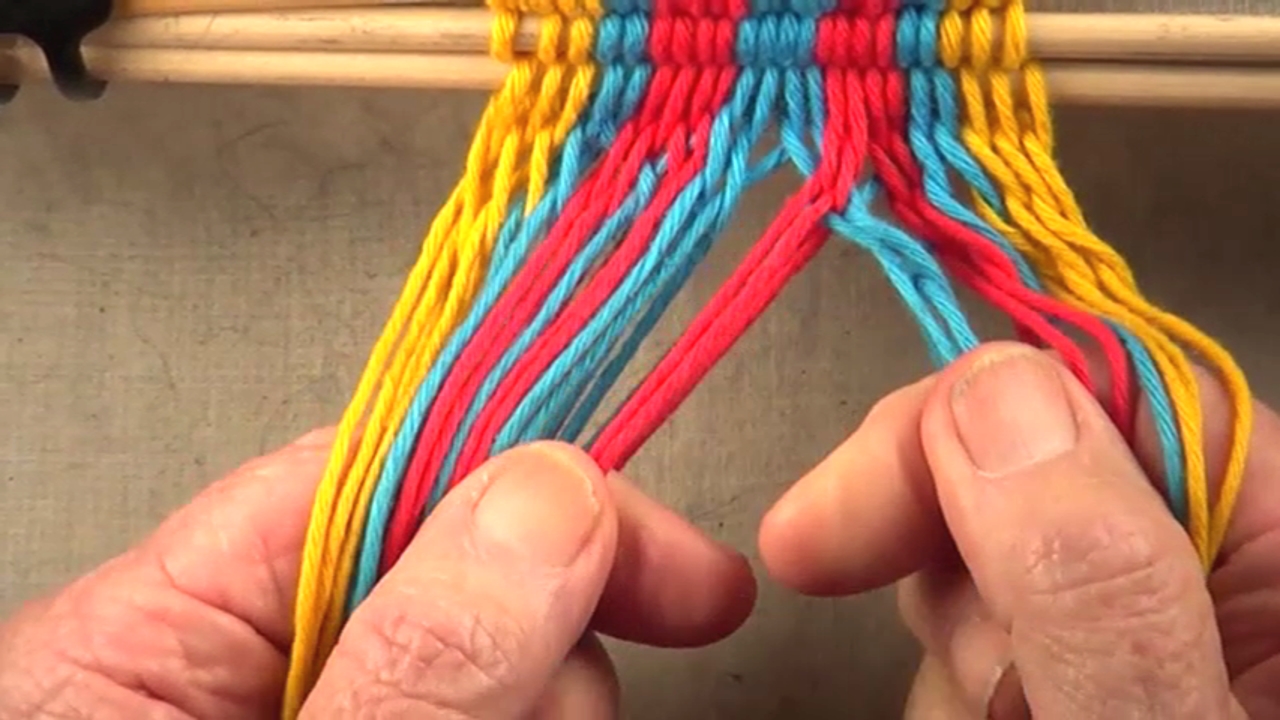
Second Pass--Section One
Pass the first top strand of the next part of the chevron interlinked strands through the shed of the second set of twining strands. |
[figure-22]
[click here to see video]
|
| Previous | Next |
|
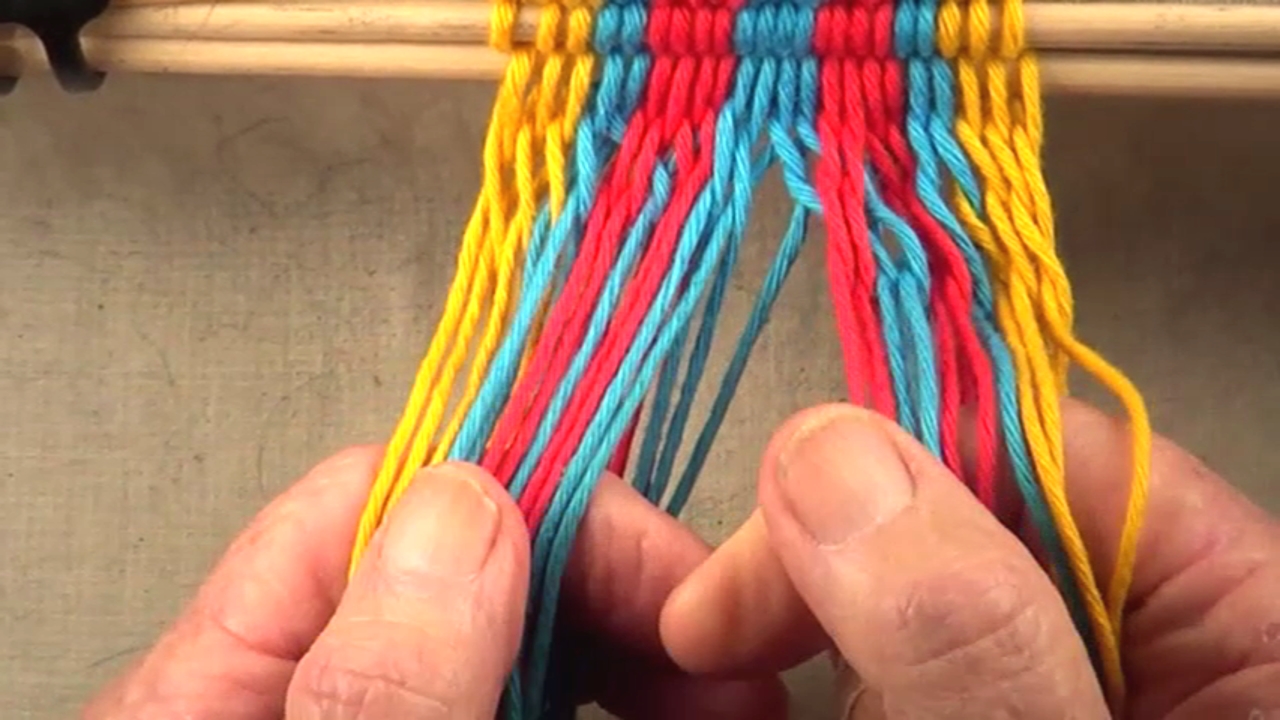
Second Pass--Section One
[S] twist twine the second set of twining strands. [NOTE] The interlink strand acts as a weft strand for the twining strands. |
[figure-23]
[click here to see video]
|
| Previous | Next |
|
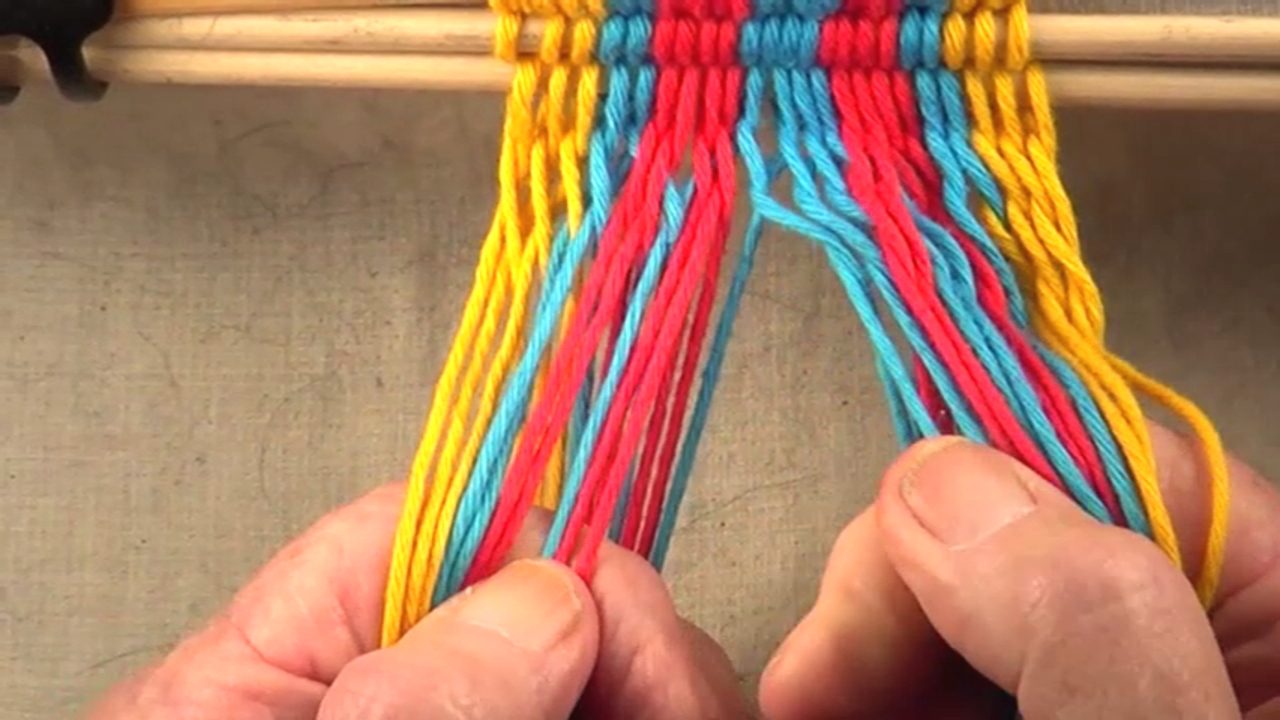
Second Pass--Section One
Continue to [S] twist interlink fingerweave until ther is one unused strand of the center color band. |
[figure-24]
[click here to see video]
|
| Previous | Next |
|
Second Pass--Section One
Pass the unused strand of the center part of the interlinked strands through the shed of the third set of twining strands. |
[figure-25]
[click here to see video]
|
| Previous | Next |